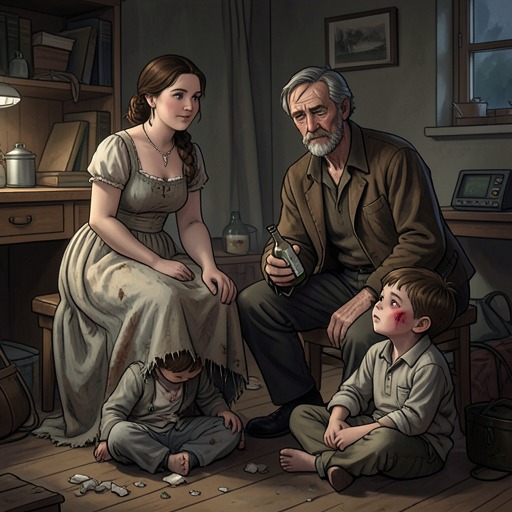
Claudia and Frieda’s sisterly bond
The Bluest EyeClaudia and Frieda’s sisterly bond becomes an act of shared responsibility when the girls decide to sacrifice their hoped-for bicycle and plant seeds for the sake of a baby whose survival seems doubtful. Their closeness is not merely companionship: it lets them make a plan together, negotiate what each is willing to give up, and hold on to hope through a small, deliberate ritual.
Shared Work and a Common Hope
The sisters have been waiting since April for the seed packets they are to sell. The summer is already thick when the package arrives, and the girls spend a major part of each day going around town to sell the seeds for five cents apiece. Their work has a concrete reward attached: the money is supposed to entitle them to a new bicycle. The promised bicycle gives their shared labor a future they can imagine and anticipate together.
Their seed-selling takes place within limits set by their mother, who has restricted them to the homes of people she knows. Even inside those boundaries, the sisters move through town as a pair, sustained by a common task and the expectation that their effort will earn something for them. The seeds first belong to an ordinary childhood bargain: packets to sell, coins to collect, and a bicycle to gain.
Deciding to Intervene
When the sisters turn their attention to the baby, they understand that their effort cannot guarantee its survival. Frieda recalls that Miss Johnson said it would be a miracle if the baby lived. The girls do not possess the power or authority of the adults around them; their confidence comes instead from pity and pride, and from the conviction that they can try to change what happens to another person.
Their discussion makes their bond active and reciprocal. Claudia asks what they will do, Frieda acknowledges the grim prediction, and the two consider prayer as a way to help. The conversation does not erase their uncertainty. It gives them a shared course of action in the face of it, allowing them to treat hope not as a certainty but as something they can attempt together.
The Sacrifice and the Plan
The girls decide to bury the money they have earned rather than use it toward the bicycle, and to plant the seeds. Claudia pauses over whether Frieda means all of the money. Her hesitation registers the real cost: the bicycle was the reward for their shared work, not an abstract possession they can give up without consequence. Frieda presses her to choose, and Claudia agrees.
They make the sacrifice concrete by deciding where to put both forms of hope. The money will be buried near the baby’s house, where they cannot return to dig it up; the seeds will be planted behind their own house, where they can watch over them. Their plan connects a distant outcome they cannot control with a living task they can tend. They agree that when the seeds come up, they will take it as a sign that everything is all right.
A Sisterly Ritual
The exchange ends with another small negotiation: Claudia asks to sing this time, while Frieda will say the magic words. The division of roles gives both girls a part in the ritual and turns their decision into a shared performance, not a private wish held by either sister alone. The playful cadence of the closing words stands beside the gravity of what they are trying to do, preserving a child's sense of magic without making the danger disappear.
In this episode, the sisters’ bond carries them from shared labor to relinquishment and mutual commitment. They cannot promise that the baby will live, and their seeds cannot make that promise true. What they can do is surrender the bicycle money, plant what remains, and watch together. Their alliance gives their limited agency a form: the effort is small, but it is chosen, costly, and sustained between them.